Gridly: 26.1K Google clicks in under six months, with no ads
- Business
- Gridly, gridly.com.au
- What it does
- Guides to EVs, chargers, solar, home batteries and heat pumps
- Market
- Australia
- Launched
- March 2026, no ads
Published 20 October 2026 by Liam Manoogian. Visit Gridly.
-
26.1K
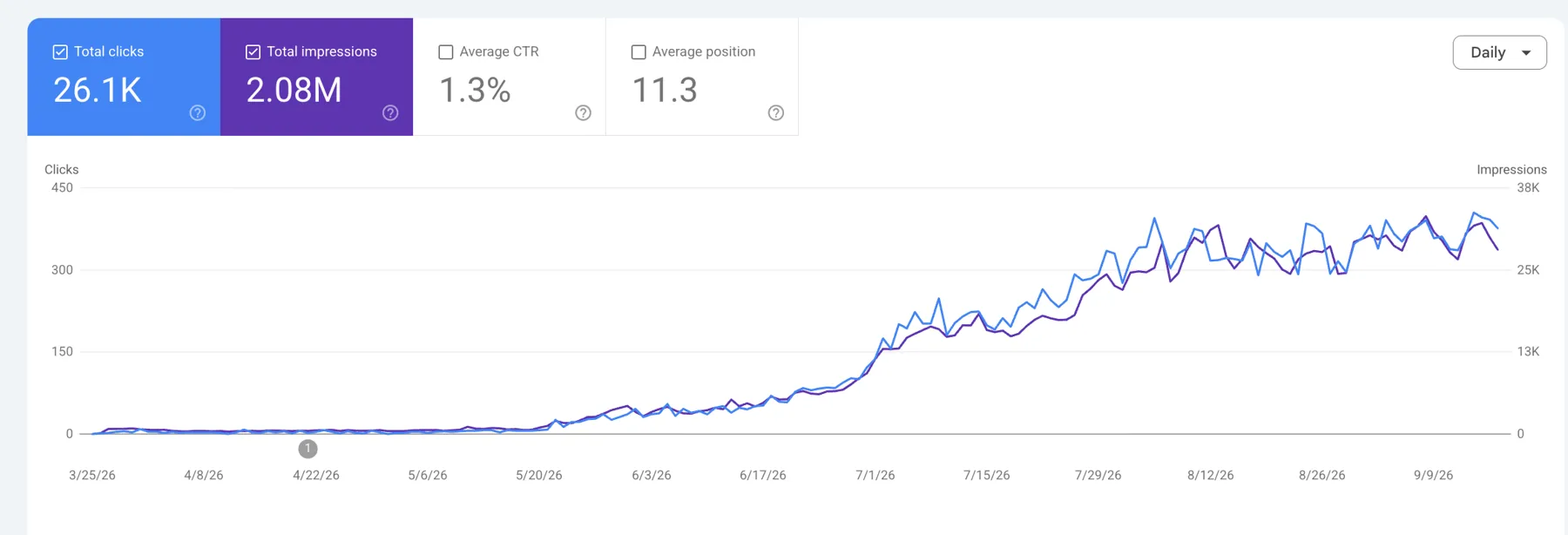
Google clicks from 25 March to mid-September 2026, with 2.08M impressions. Source: Google Search Console.
-
508
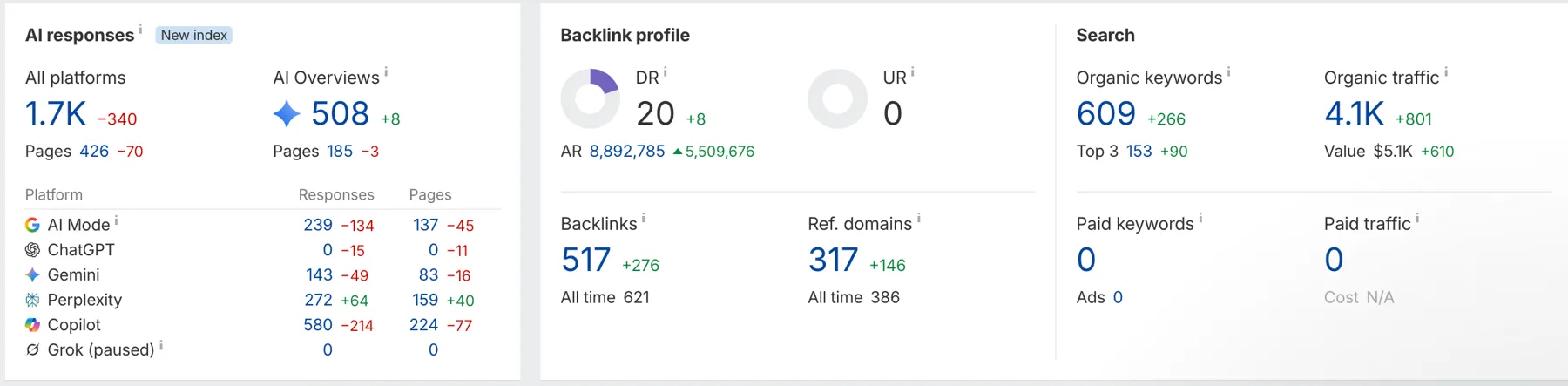
Google AI Overviews citing Gridly in October 2026, among 1.7K AI responses across platforms. Source: Ahrefs.
-
153
keywords ranking in Google's top three, out of 609 ranking keywords in October 2026. Source: Ahrefs.
-
~50
quote requests a month from readers, as of October 2026. Source: Gridly.
Where Gridly started
Gridly is an Australian guide for households weighing up electric vehicles, novated leasing, EV chargers, solar, home batteries and heat pumps. It launched in March 2026 on a new domain, with no advertising budget and no search history. It has never run paid ads.
The topics are crowded. Large comparison sites, publishers and manufacturers already write about them, and the facts change often: rebates, tariffs, EV prices and model line-ups move several times a year. A guide that gets a rebate amount wrong loses trust quickly, with readers and with search engines.
What was built
Gridly's SEO and content system was built by Liam Manoogian, Galactia's founder, with the Gridly team. It is the same method we use for clients, applied to a publisher instead of a local business.
One source of truth for every figure
Gridly keeps its key Australian figures in a knowledge hub: rebates by state, electricity tariffs, feed-in tariffs, EV prices and specifications, each with a source and a date. Articles quote the hub instead of retyping numbers, and specifications must come from Australian sources, because ratings and prices often differ from overseas models.
Pillar pages with a cluster around each
Each topic has a pillar page, such as home batteries, EV chargers and novated leasing. Product pages, state rebate pages and articles link up to it, and every new article must link to its pillar by its canonical address. A duplicate check runs before anything is written, so two pages never compete for the same search.
Articles built from real questions
Topics come from the questions Australians ask in EV and solar communities online, matched against Search Console data. Each article is researched across at least five independent sources, answers its question in the opening paragraph, and carries FAQs and structured data. Before publishing, every figure is checked so that the same number appears the same way everywhere on the page.
House rules for the writing
A written set of content rules covers voice, Australian spelling, banned filler phrases, how to cite statistics, and which sites may be linked. Outbound links go to manufacturers' Australian pages and government sources only. These rules are what keep a fast publishing pace from turning into thin pages.
Where it landed
Clicks from Google were close to zero through April and May while the site was new. They climbed from June and were regularly above 300 a day by September. Over the whole period to mid-September, Search Console recorded 26.1K clicks and 2.08M impressions at an average position of 11.3.
The AI results came with the search results. In October 2026, Ahrefs recorded 508 Google AI Overviews citing Gridly and 1.7K AI responses across platforms: Copilot (580), Perplexity (272), Google AI Mode (239) and Gemini (143). ChatGPT showed none at the time. Gridly also had 609 keywords ranking in Google, 153 of them in the top three.
Traffic is only useful if it turns into enquiries. As of October 2026, Gridly receives around 50 quote requests a month from readers.
What we learned
Our reading is that accuracy compounds. The knowledge hub and the figure checks slowed early publishing, and the pages that answer a specific question with correct, dated figures are the ones we see cited. We can't isolate which factor mattered most, but Gridly shows a new domain can be cited in AI answers within months of launch.
Visibility differs by engine. Gridly is cited widely by Copilot, Perplexity and Google's AI features, but ChatGPT showed no responses in the same period. Measuring each engine separately is the only way to see that, which is why our monthly reporting checks them one by one.
The same approach applies to a local business, at a smaller scale: one source of truth for your facts, a page for each question customers ask, and checks before anything goes live. Our AI SEO services page explains how we apply it, and our guide to LocalBusiness structured data covers the first fix most local sites need.
See where your site stands
Get a free strategy: how Google and AI crawlers see your site, and the order we'd fix it in. We reply within 24 hours.